
SUIBROKERS DAO · field note
Meme stocks and tokenized exposure: community, markets, and rights
A guide to distinguishing social attention, tokenized exposure, equity rights, and community utility.
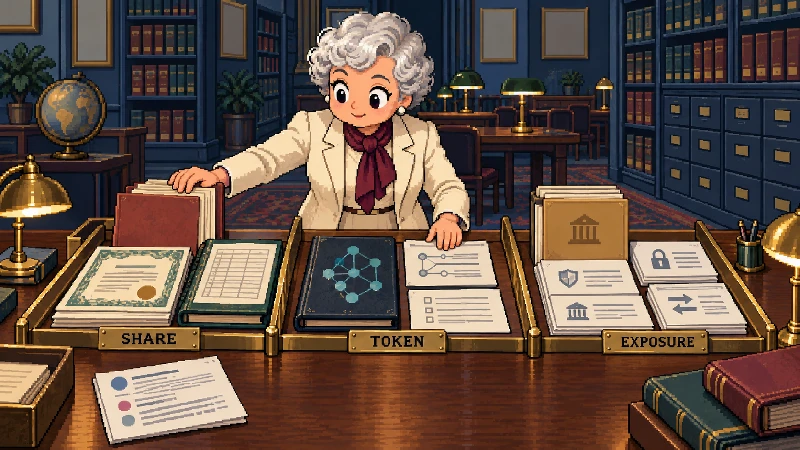
“Meme stock,” “meme token,” and “tokenized stock exposure” can share a ticker or a social narrative while representing different instruments. The useful first question is not which one is more popular. It is what legal or technical claim the holder receives, where the claim settles, and which records prove ownership or payment.
Three instruments with different rights
| Instrument | What the holder has | Where it settles | First evidence to read |
|---|---|---|---|
| Listed meme stock | A share in a company under the broker and market rules | Securities account and exchange or clearing records | Issuer filings, share class, broker terms, corporate actions |
| Meme crypto token | A blockchain token controlled by a contract and network | Onchain transfer and token contract state | Official contract, network, supply rules, holder functions |
| Tokenized stock exposure | A product claim whose value references a stock | Issuer ledger, custody or derivative records, and possibly a chain | Issuer terms, redemption, custody, insolvency, and transfer rules |
Listed meme stock
A listed share is an equity instrument issued by a company and traded through a securities market. A holder may have voting, dividend, corporate-action, and residual-claim rights depending on the share class and the broker’s custody arrangement. A fast-moving social narrative can change demand without changing those underlying rights. The market price may move while the issuer remains responsible for the company’s disclosures and corporate actions.
Check the issuer, ticker, exchange, share class, settlement date, borrow or short-sale rules, and what the broker says about voting and dividends. A screenshot of a viral post proves attention at a time; it does not prove that a reader owns a share or that a corporate action was received.
Meme crypto token
A meme token is a blockchain asset. Its holder usually has the transfer and contract rights specified by the token and network, rather than a claim on a company’s earnings or board. DOGE’s official explanation presents a payment and community role, while the official PEPE site describes an Ethereum token, its supply, and its acquisition route. Those descriptions help identify network and token mechanics; they do not create stock ownership.
For a token, resolve the full contract address, chain, decimals, supply controls, transfer restrictions, and any fee or burn behavior. The network record can prove that a token moved. It cannot by itself prove that the issuer owes a dividend, will redeem it, or will maintain a market.
Tokenized stock exposure
Tokenized exposure needs a separate issuer analysis. The token may represent a derivative, a debt-like claim, a custodial interest, or another product whose terms reference a stock. “Backed” or “tokenized” does not answer whether the holder can vote, receive dividends, redeem for shares, transfer freely, or rank against the issuer in an insolvency. Robinhood’s Chain documentation describes tokenized real-world-asset infrastructure; the individual product terms decide the rights.
Ask what happens if the reference exchange closes, the issuer pauses transfers, the stock pays a dividend, the reference company delists, or the token issuer fails. A chain transaction may settle the token leg while custody or issuer records settle the reference claim later, or not at all under the stated terms. Keep those records separate.
Keep social trading in its own layer
Social feeds, alerts, and leaderboards are discovery tools. They can supply a timestamp, thesis, or attention signal, but they do not change an instrument’s rights. A reader should preserve the original post, identify whether it discusses a share, a token, or an exposure product, and then verify the relevant issuer, contract, venue, and settlement record. A chart shared across communities can describe different assets with similar symbols.
For one bounded product example, a reader who classifies a Sui token can inspect the exact supported asset and route in SUIBROKERS Swap, review the wallet prompt, and preserve the confirmation record. That is a Sui application action, not an equity right and not proof that a meme narrative has become a listed security. Current Swap and Desk workflows are separate from the planned SUIBROKERS token and Broker/NFT paths; no current price, TGE, or final economic result is supplied.
Before comparing outcomes, label the instrument, issuer or contract, market, rights, and settlement evidence. That classification prevents a social signal from being mistaken for ownership and prevents a token transfer from being described as a share transfer.