
SUIBROKERS DAO · field note
SUIBROKERS and SHIB: token, NFT, and ecosystem design
A non-promotional comparison of token role, NFT role, community activity, and ecosystem mechanics.
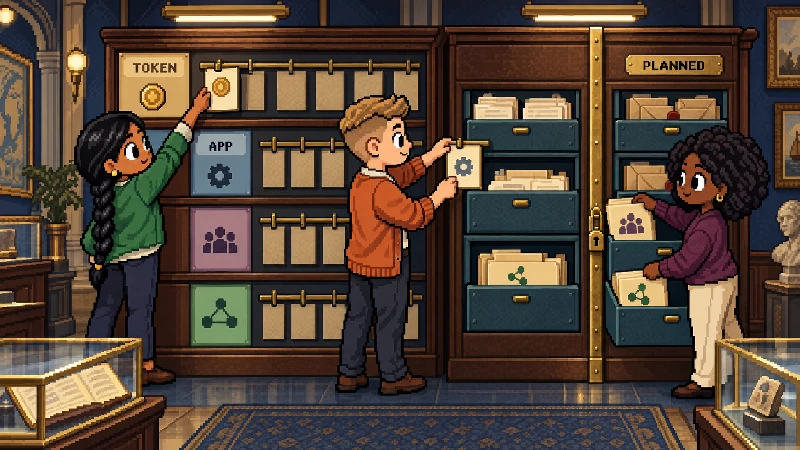
SHIB and SUIBROKERS illustrate two different ways a crypto project can describe an ecosystem. The official Shib home page lists multiple tokens, applications, community surfaces, developer tools, NFTs, and a network entry point. SUIBROKERS currently has product workflows on Sui, while its token activation, Broker PCs, and NFT Vault remain planned. A useful comparison maps each layer to a user action instead of comparing a community label with a price.
What the SHIB site actually lists
The official Shib ecosystem site groups its public surface into named layers. Under tokens it lists SHIB, BONE, LEASH, and TREAT, alongside ShibaSwap. Under ecosystem and community it lists ShibDAO, ShibIdentity, DeFi, ShibTheMetaverse, NFTs, a DappStore, and community publications. Under developers it links Shibarium, a developer portal, and tools for building or listing dapps.
Those links establish an ecosystem map: token names, application names, governance or identity labels, NFT and metaverse surfaces, and developer entry points. They do not by themselves define the legal rights of each token, prove that every application is available to every wallet, or guarantee that an ecosystem feature produces value. Read the linked application’s own documentation before treating a label as a mechanism.
The SUIBROKERS layers are narrower
The project’s Broker documentation defines a Broker NFT supply of 8,888. Its current Farm allocation and service rules allocate 1,000 NFTs across four seasons, with 225 verified-activity places and 25 Partner Trust places in each season. A planned Claim path accounts for 3,444 NFTs and requires planned token activation; a planned Vault path accounts for 4,444. Claim and Vault are not live.
The same documentation lists Farm thresholds of 1,000, 2,000, 4,000, and 8,000 Points across four seasons. The project’s token documentation describes a planned one-billion-token supply and planned activation or level utility. These numbers explain a proposed product relationship: verified activity or Partner Trust can relate to Farm qualification, while a future token could relate to activation. They do not make the token a live payment asset or make a threshold an NFT guarantee.
Current SUIBROKERS work is a separate layer. Swap is a wallet-reviewed Sui route, The Desk is a provider-backed request flow, and Partners has its own attribution and ledger rules. Current use does not require holding the planned token.
| Layer | SHIB ecosystem source | SUIBROKERS current/planned source |
|---|---|---|
| Token layer | SHIB, BONE, LEASH, and TREAT are listed names | Planned one-billion-token allocation and future activation |
| Application layer | ShibaSwap, DeFi, DappStore, and listed ecosystem surfaces | Current Swap, The Desk, Farm, and Partners |
| NFT/community layer | NFTs, ShibDAO, ShibIdentity, and community surfaces are listed | Broker NFT Farm is current in its service rules; Claim, PCs, and Vault paths are planned |
| Network/developer layer | Shibarium and developer tools are listed | Sui wallet and object/product rules govern current flows |
| Evidence needed | Each token, app, contract, and network’s own docs | Current app record, Sui effects, service ledger, and final token docs |
Use a layer-by-layer question
If a reader asks whether a Broker NFT is “like SHIB,” first ask which layer they mean. A token comparison requires token contract, supply, and utility. An NFT comparison requires ownership, access, and transfer rules. An application comparison requires the user journey and transaction evidence. A network comparison requires the chain, wallet, gas, and developer interfaces. The Shib home page’s breadth does not make every listed object equivalent to a Broker.
The same method avoids a product shortcut. Seeing SHIB and SUIBROKERS in one social post does not establish a route, partnership, or shared ecosystem. Read the official Shib page for its named surfaces and the current SUIBROKERS docs for current actions; read final token and NFT contracts only when those planned mechanics become live.