
SUIBROKERS DAO · field note
Tokenized stocks: ownership, claims, and settlement
A plain-language guide to the rights, claims, settlement, and counterparty questions behind tokenized stock products.
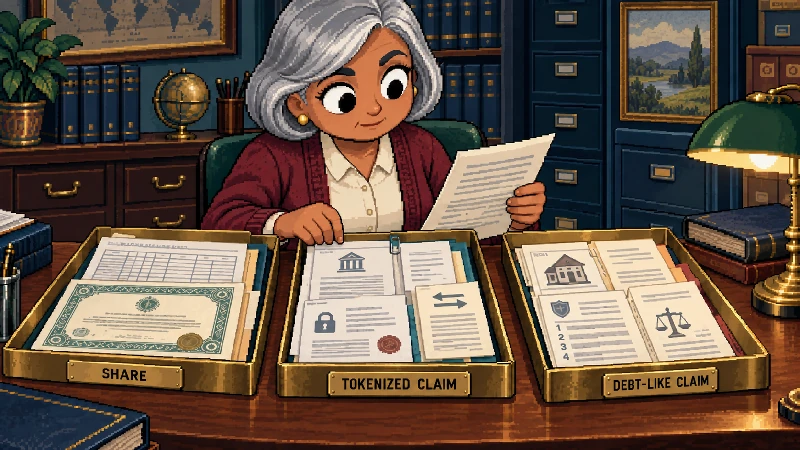
A token with a stock symbol is not automatically a share in the company named by that symbol. The holder’s rights come from the issuer’s legal terms, the custody or reference arrangement, and the way the token settles. Start with those documents before looking at a chart.
Separate the instrument types
Direct equity, a tokenized claim, and debt-like exposure can all track the same reference price while creating different rights.
| Instrument | What the holder may have | What must be verified |
|---|---|---|
| Direct share | Ownership recorded through the issuer’s market and custodian, with rights defined by the share class | Register or broker record, voting terms, dividends, custody, and settlement |
| Tokenized exposure | A contractual or platform claim linked to an underlying stock’s economics | Issuer, redemption, corporate actions, transfer limits, chain, and counterparty |
| Debt-like token | A claim against an issuer or obligor, potentially referencing a stock | Priority, collateral, default, insolvency, payment terms, and redemption |
The symbol and token balance do not answer these questions. A price feed can show reference exposure without creating voting, dividend, liquidation, or delivery rights.
Read the issuer’s wording
Robinhood’s Chain documentation describes an EVM-compatible Layer 2 and infrastructure for tokenized real-world assets. Its stock-token documentation describes the issuer’s stock tokens as debt securities that provide economic exposure to an underlying stock without legal or beneficial ownership rights in that company. Robinhood’s European FAQ uses a separate derivatives-contract framing for its European product. Those sources show why “tokenized stock” is not one universal legal category.
For a particular product, record the issuer, jurisdiction, governing terms, reference asset, token contract, chain, and any restriction on who may buy or transfer it. Then find the clauses for dividends or equivalent payments, voting, splits, mergers, redemption, trading hours, fees, and what happens if the issuer or reference provider fails.
Settlement is a separate question
Settlement describes how a trade becomes final. A direct share may settle through a regulated broker and custodian. A tokenized product may settle as an onchain transfer while the holder’s economic claim remains against an issuer or intermediary. The network transaction proves that a token moved; it does not by itself prove that the referenced share moved or that a redemption obligation is solvent.
Ask four questions for every trade:
- Which asset moves onchain, and what contract controls it?
- Who is the legal issuer or obligor after the trade?
- What event makes the claim redeemable, and in which currency or asset?
- Which record proves final settlement: chain effects, issuer ledger, custodian statement, or all three?
An approved wallet and a successful transaction answer only the network part. They do not remove issuer, custody, market, or legal risk.
Test the rights with scenarios
Dividend. A direct shareholder may receive a dividend under the share class and record date. A tokenized product may distribute an equivalent payment, retain it, or exclude it under its terms. Read the contract rather than inferring a dividend from the stock symbol.
Insolvency. A share holder and a debt holder sit in different legal positions. If a token is a debt security, the central question is the holder’s claim against the issuer and its priority in a failure. The reference company can perform well while the token issuer has a separate problem.
Market closure or transfer halt. The reference exchange can be closed while a token venue remains open, or the issuer can pause transfers. A continuous token price does not guarantee continuous redemption or access to the underlying market.
Corporate action. A split, merger, or delisting may require an issuer adjustment. The token contract, administrator, or offering terms should state who makes that adjustment and how a holder is notified.
Avoid the price shortcut
Two instruments can track a similar chart and still differ in custody, redemption, counterparty, tax, transferability, and insolvency risk. A tokenized claim can be useful exposure for a defined user, but its usefulness depends on its terms. “Backed,” “synthetic,” “tokenized,” and “onchain” are descriptions to unpack, not guarantees of ownership.
Read the Robinhood Chain overview and the specific issuer’s terms together. Keep the stock’s rights, the token’s contract, and the settlement record as separate evidence.