
SUIBROKERS DAO · field note
PONS fees, buybacks, and burns: how the mechanisms work
A mechanism-first explanation of fee collection, buyback policy, burn events, and their effects on supply narratives.
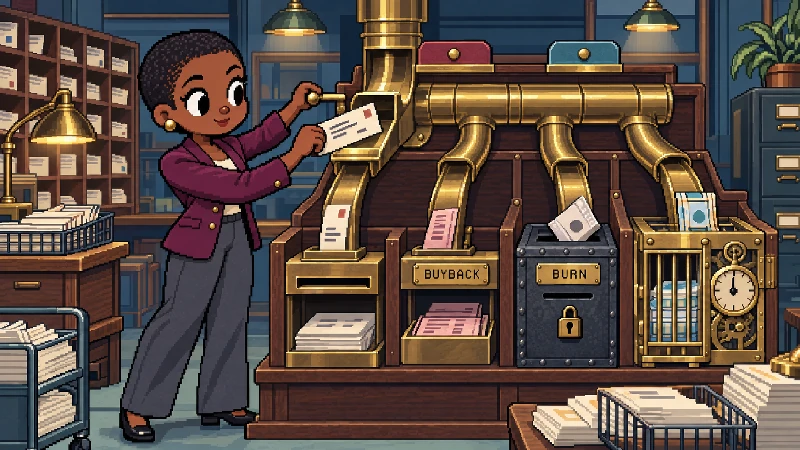
Fee, buyback, burn, lock, and vesting describe different ledger events. A fee charges a trade or launch. A buyback spends an asset to purchase tokens. A burn sends tokens to an address that cannot spend them. A lock keeps tokens unavailable for a period. A vest releases locked tokens according to a schedule. The pons version and token address determine which event a reader is actually discussing.
v1: pool fees and protocol buybacks
The current v1 documentation describes a pool-first launch on Robinhood Chain. Each token trades against WETH in its own pool. The active configuration lists a 1% pool fee and a split of creator 70% and protocol 30%; legacy launches retain a 90/10 split. The docs say the split is snapshotted when each token launches, so a reader must identify the factory and launch date before applying a percentage.
The same page describes protocol revenue separately from creator fees. It says 80% of protocol fees are used for an automated TWAP buyback and 20% for infrastructure and team costs, while also saying the arrangement is not yet immutable. The protocol buyback purchases PONS and sends it to a burn address. That reduces the recorded circulating supply of the PONS token under the described mechanism. It does not burn an individual launch token, and it does not guarantee a higher price.
v2: fee, creator tax, and optional buyback
The v2 documentation describes a curve-first launch that later graduates into a locked Uniswap v4 pool. It distinguishes a standard trading fee, shared between pons, the creator, and buyback, from an optional creator tax that the creator sets at launch. The creator tax goes to the creator, is capped, and is fixed for that launch. The fee rate remains the same before and after graduation; the graduated Uniswap pool itself does not add a separate pool fee under the described design.
V2 pays creators in the launch’s pairing asset. An ETH-paired launch pays ETH; a launch paired with another approved token pays that token. Post-graduation fee balances can contain both sides of the pool, so the system may convert the launch-token side before crediting the creator or protocol ledger. This is cashflow conversion, not a burn.
An optional v2 creator buyback uses part of the creator’s share to purchase the launch token. The docs explicitly say those bought-back tokens are not burned. They are locked in a buyback vault and released gradually over five years to the creator and protocol beneficiaries. A later buyback has its own weighted vesting start, and a buyback can be skipped if liquidity is too thin or the trade would move price too far. A buyback therefore changes token custody and future release accounting; it does not automatically reduce supply.
Follow one fee through the ledger
Use a dated, chain-specific record. Suppose a v2 launch charges a standard trading fee and an optional creator tax on a purchase:
- The buyer spends the approved pairing asset.
- The fee and tax are recorded under the launch’s fixed policy.
- The protocol share, creator share, and any buyback allocation are separated.
- If a buyback runs, the pairing asset purchases the launch token and the purchased tokens enter the vesting vault.
- If the launch token later graduates, pool fee balances may be converted before payout.
At no point should the reader label the entire fee as “burned.” To claim a burn, identify the token contract, the burn address, the transaction, and the resulting supply state. To claim a buyback, identify the purchase transaction and whether the bought tokens were burned, locked, or sent to a beneficiary. To claim a payment, identify the recipient and asset.
What to record
| Question | Evidence |
|---|---|
| Which rule applies? | v1 or v2, factory, launch time, and contract state |
| What was charged? | Standard fee, creator tax, launch fee, or gas |
| Which asset moved? | WETH, approved pairing asset, PONS, or launch token |
| Who received value? | Creator, protocol, buyback vault, burn address, or escrow |
| What is the post-event state? | Paid, bought, burned, locked, vested, or pending |
Do not transfer the v1 PONS buyback policy to a v2 launch token. Do not treat a creator’s v2 buyback as a supply burn. Do not assume a current documentation percentage applies to a legacy launch whose terms were snapshotted earlier.
Read how the pons pool, curve, platform, and token fit together and the Robinhood Chain docs before interpreting a live contract record.